

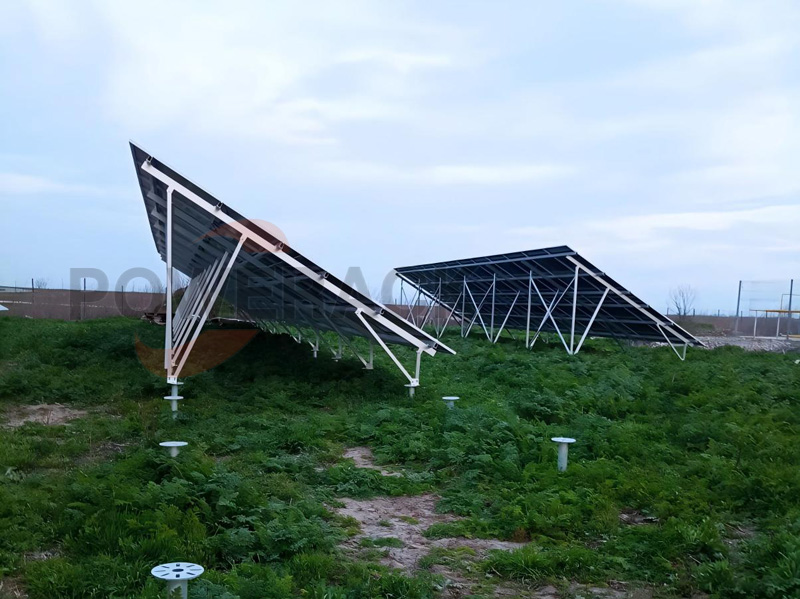
The power generation efficiency of photovoltaic modules is highly sensitive to temperature; for every 1°C increase in module temperature, the output power decreases by a certain amount. The key advantage of ground-mounted racks is that they provide a ventilation gap beneath the modules, which helps cool them down and improve efficiency.
The elevated mounting structure raises the solar panels, creating a layer of circulating air between the underside of the panels and the roof or ground. When sunlight hits the modules, a significant amount of heat accumulates on their backs; natural wind can flow through the gap created by the elevated structure, continuously dissipating the heat from the back of the panels and lowering their operating temperature. Compared to a flat-lay installation that lies directly against the roof, the elevated structure prevents heat from becoming trapped between the panels and the roof, thereby avoiding heat buildup.
Lower temperatures yield direct benefits: the lower the operating temperature of the modules, the less power degradation occurs. Under the same lighting conditions, ground-mounted photovoltaic arrays generate more electricity overall. The difference in heat dissipation is most noticeable during periods of high summer temperatures, resulting in even more significant gains in power generation.
In addition to heat dissipation, the space between the mounting frames offers additional benefits: it reduces secondary heating of the modules caused by thermal radiation from the roof; it facilitates future inspections and cleaning of the modules; and it prevents the roof’s original waterproofing layer from being damaged by being covered and trapped under the modules, thereby extending the roof’s service life.
Of course, a higher mounting structure isn’t necessarily better. Raising the mounting structure increases material and construction costs, and the height is also constrained by local wind speeds, loads, and site conditions. Structural design must be based on wind load calculations to balance power generation gains with investment costs.
FAQ
1. What is the optimal height for elevated mounting systems to achieve the best heat dissipation?
Standard roof-mounted systems are typically elevated by ≥20 cm. Higher elevations improve ventilation, but they also increase wind loads, so structural calculations must be performed based on local wind speeds.
2. Can elevated mounting systems increase power generation in all scenarios?
No. In low-lying areas with extremely poor ventilation or in regions with little to no wind year-round, the benefits of heat dissipation are limited; in high-wind areas, the wind resistance of the mounting system must also be carefully evaluated.
3. By how much can elevated mounting increase power generation?
Generally, compared to installations laid directly against the roof, overall power generation in high-temperature summer environments can increase by 3% to 8%, depending on ventilation conditions, solar irradiance, and ambient temperature.
ETIQUETAS :
Add : 606, No. 12, Huasheng Road, Huli District, Xiamen,China
WhatsApp : +86153 9592 2968
Correo electrónico : info@powerack.com



 español


